✦ In this postReady-to-use French and English wording for every piece of your bilingual wedding invitation suite, from save the dates and invitations to RSVPs and dress codes.
If you’re planning a wedding in two languages, your invitation suite is the first place to start. A bilingual invitation is more than just a translated invitation, it’s a welcome extended equally to both sides of your family, so that a grandmother in Lyon and an uncle from New York open the envelope and already feel the warm energy of your wedding.
Below you’ll find wording for every piece of the suite, save the date, the invitation, ceremony and reception cards, dress code, and RSVP, with ready-to-adapt examples in both languages. To make it easy to match your own vibe, examples are given in three different tones: formal, middle, and relaxed. Pick the level that fits your wedding and keep it consistent across the whole suite.
One quick note before we start: formal, parent-named invitations exist in both languages. English traditionally names the hosting parents, and French does too. Where the old-fashioned French formula goes further is in naming both sets of parents, and sometimes all four grandparents. But these days, couples are most likely to invite guests warmly and in the first person. This guide gives you a range, from the fuller traditional phrasing all the way to relaxed, modern wording as well as useful grammar tips!
SECTION 1
Save the Date
Save the dates are informal by nature, so this is the easiest piece to make bilingual. Keep it short and set the tone of your wedding through your words. One small formatting note before you start: in French the day comes before the month, the month is lowercase, and there’s no comma, so it’s 12 juin 2027, not “Juin 12.” The first of the month is the one exception, written as 1er, for example le 1er juin.
Formal
Emily Carter and Thomas Dubois
June 12, 2027 · Provence, France
Formal invitation to follow.
Emily Carter et Thomas Dubois
12 juin 2027 · Provence, France
Invitation à suivre.
Middle
Join us in France September 18, 2027
Formal invitation to follow.
Retrouvez-nous en France
18 septembre 2027
Invitation à suivre.
Relaxed
SHOP BILINGUAL SAVE THE DATES →
SECTION 2
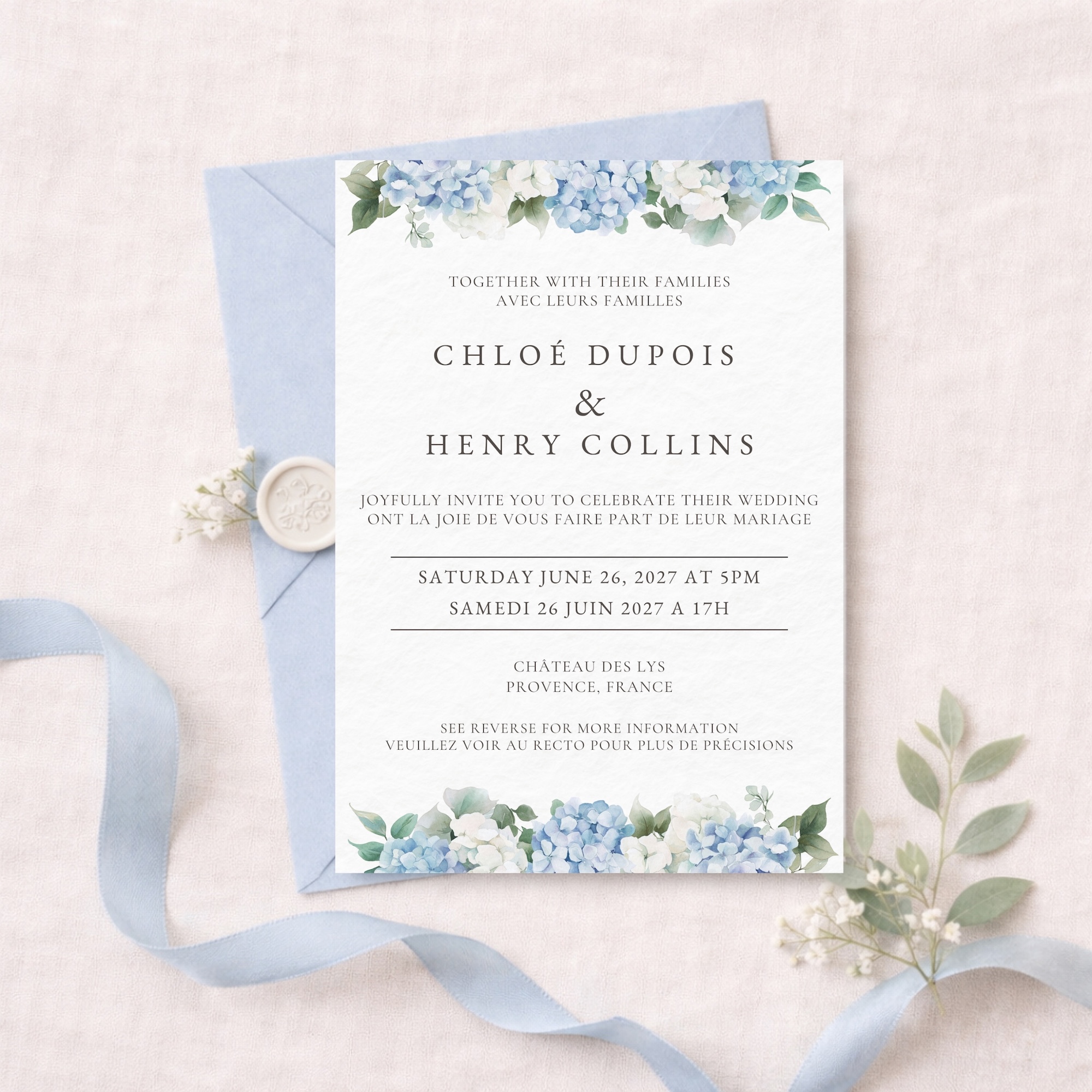
The Wedding Invitation
This is the heart of the suite. The examples below move from a traditional, family-centered formula down to something intimate and first-person. The formal French version uses the traditional faire-part wording, “Ont l’honneur de vous faire part de” (“have the honor of announcing to you”). It is the most ceremonial phrasing you can choose, the equivalent of “request the pleasure of your company” in English. Another detail to keep in mind is the time format. French uses the 24-hour clock, so 4:00 p.m. is seize heures or 16 h.
Formal
Saturday, the twelfth of June two thousand twenty-seven at four o’clock in the afternoon
Château de Tourreau, Provence, France
Dinner and dancing to follow.
le samedi 12 juin 2027 à seize heures
Château de Tourreau, Provence
Cocktail, dîner et soirée dansante à suivre.
Middle
Relaxed
When the parents are hosting
If one or both families are formally issuing the invitation, use this framing. Traditionally the bride’s parents host and she’s named by first name only. Adapt freely to your own families.
SECTION 3
Ceremony and Reception
If your ceremony is at a separate time or place from the reception, give it its own line or card. One lovely French term to know here: the cocktail hour or drinks reception right after the ceremony is called the vin d’honneur. Worth using on the French side if you want a touch of local flavor!
4:00 PM
Saint-Pierre Church
Reception to follow.
16 h 00
Église Saint-Pierre
Vin d’honneur et dîner à suivre.
SECTION 4
Dress Code
Beyond the translation itself, dress codes mean different things to different cultures. What reads as “cocktail attire” to an American guest might feel very different to a French, Spanish, or Italian guest with their own cultural expectations around wedding attire. For a bilingual or multicultural wedding especially, it’s worth going beyond the label and adding a line of context to help your guests. Your wedding website is the perfect place to do this, check out French-English wedding website wording here.
- Black Tie → Tenue de soirée
- Formal Attire → Tenue de cocktail
- Cocktail Attire → Tenue de cocktail
SECTION 5
RSVP
Did you know that RSVP is already French? It stands for Répondez s’il vous plaît. Both sides of your guest list already understand the abbreviation, so what you’re really translating is everything around it.
Formal
___ Accepts with pleasure
___ Declines with regret
___ Avec plaisir
___ Avec regret
Relaxed
☐ Joyfully accepts
☐ Regretfully declines
☐ Avec grand plaisir !
☐ Absent(e) mais de tout cœur avec vous
☐ Beef ☐ Fish ☐ Vegetarian
☐ Bœuf ☐ Poisson ☐ Végétarien
Dietary restrictions:
EnglishPlease list any dietary restrictions.
FrenchMerci d’indiquer toute restriction alimentaire.
SECTION 6
How to Lay Out Both Languages
There are several ways to lay out bilingual wedding invitations. No single layout is correct, it’s a matter of understanding your guest language mix and design preferences.
Separate versions for each guest. Create two different invitations, one fully in English and one fully in French, then distribute based on each guest’s primary language. This keeps each invitation clean, uncluttered, and feels like it was written specifically for that person. It does require printing two versions but for smaller weddings it’s a very elegant solution.
Front and back. Have one language per side. This is another clean alternative. The subtle catch: whichever language is on the front reads as “primary,” so choose intentionally.
A naturally bilingual design. Use a bilingual invitation template designed to showcase both languages on the same card. This is the most visually dynamic approach and instantly communicates the multicultural spirit of your wedding without guests even reading a word. If you want to see how this looks in practice, browse our bilingual invitation templates designed specifically for French-English weddings.
SECTION 7
Five Translation Traps to Avoid
1. Format the date the French way. Day before month, lowercase month, no comma: le 12 juin 2027. The first of the month is 1er.
2. Use the 24-hour clock in French. 4:30 p.m. is 16 h 30.
3. Mind the French space before punctuation. In French there’s a space before ! ? : ; and » — so it’s “Serez-vous présent ?” with a space, not “présent?”.
4. “Entrée” is a false friend. It’s the starter in French, the main course in English. Use plat for the main dish on your French RSVP card.
5. Get names and accents right. Zoé, Loïc, Adélaïde. Many French names use accents, be sure to proof every name and use a font that all accents available.
Final Thoughts
Yes, a bilingual invitation suite is a little extra work, but your invitations are the very first thing to set the stage for your wedding day. Taking the time to translate that warm welcome, so every guest and both sides of the family feel spoken to, is so worth it. Communication is everything and your invitations are where it starts: they set the tone and carry the energy you want your whole wedding to feel like.
And if you’re working through all the other bilingual elements of your ceremony, our guide on how to plan a beautiful bilingual wedding ceremony is a great next step. And for tips on making every guest feel included across the entire wedding weekend, read our guide on 10 tips to make guests feel included at a bilingual wedding.
✦ From our shop
Save the dates, invitations, RSVP cards, ceremony programs, and more, in French and English. Easy to customize, instant download.
Frequently Asked Questions
How do you write a bilingual French-English wedding invitation?
Choose one register (formal, middle, or relaxed) and apply it consistently across both languages throughout the entire suite. Use the traditional French faire-part formula for formal wording, or a warm first-person approach for something more modern. Keep the couple’s names, date, and venue visually identical in both languages, and let each language follow its own grammar rules rather than forcing a literal translation.
How do you format dates on a French wedding invitation?
In French the day comes before the month, the month is lowercase, and there’s no comma: le 12 juin 2027. The first of the month is written 1er. Times use the 24-hour clock: 4:00 p.m. is seize heures or 16 h.
What does “faire-part” mean in French wedding invitations?
Faire-part is the French term for a formal wedding announcement or invitation. The phrase “ont l’honneur de vous faire part de” translates roughly as “have the honor of announcing to you” and is the most traditional, ceremonial wording you can use on a French wedding invitation. It’s the equivalent of “request the pleasure of your company” in English.
Should French or English come first on a bilingual wedding invitation?
There’s no strict rule. A graceful default is to put the language of the wedding location on the front or first column. Whichever language appears first or on the front will read as the “primary” language, so choose intentionally based on which guest group you want to honor in that position.
What is the French equivalent of “cocktail attire” for a wedding dress code?
Tenue de cocktail covers both cocktail attire and formal attire in French. For black tie, use tenue de soirée. For a garden party or outdoor setting, tenue élégante de jardin works well. Avoid literal translations of English dress code terms since they don’t carry the same meaning in French.